
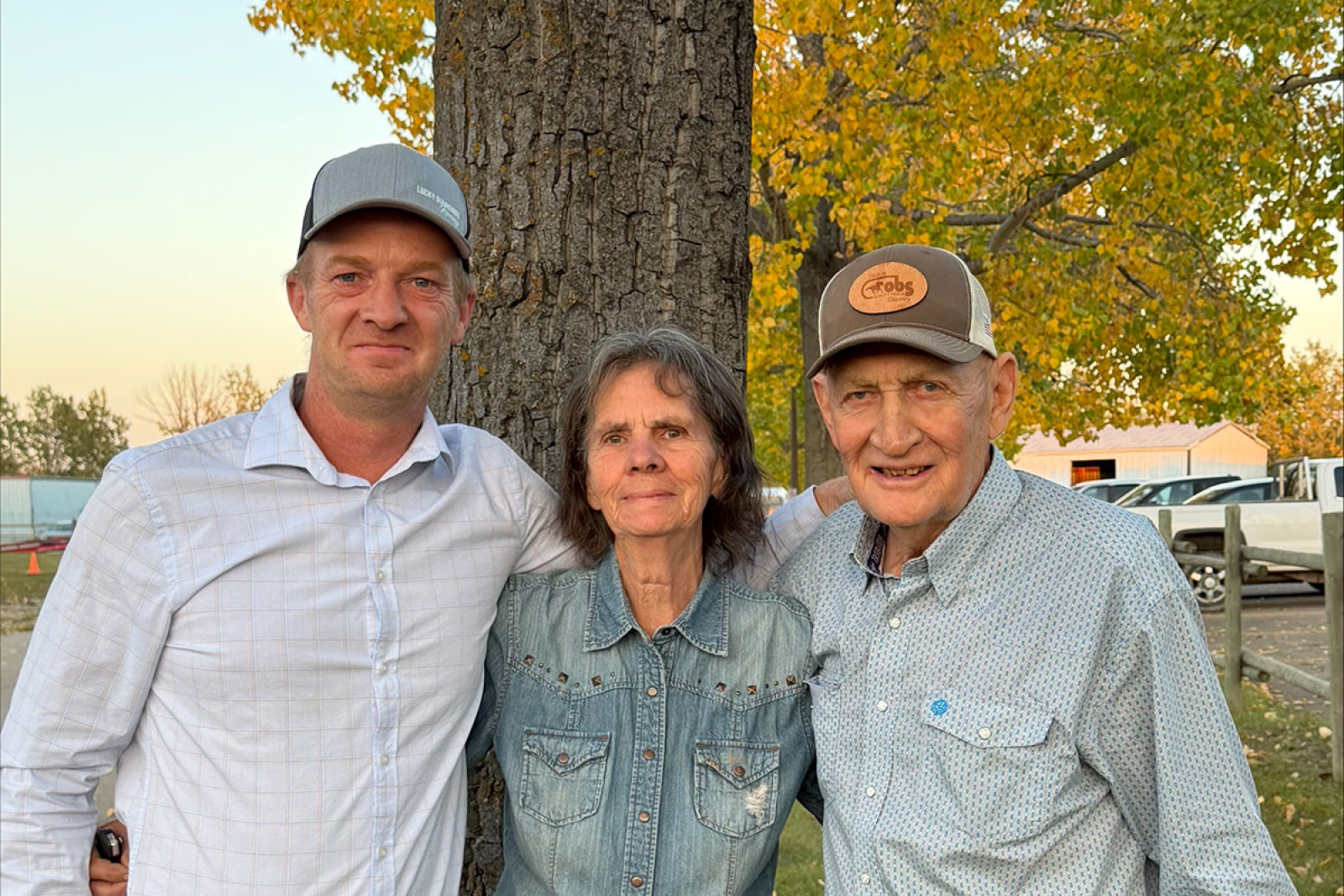
For decades, Bill and Shirley Matier have been part of the fabric of Alberta horse racing. First as Thoroughbred trainers and owners, then as breeders, they have bred, raised, trained and cheered on generations of horses. Their story is also the story of a time when Alberta racing was smaller, more personal and deeply connected to the people who made it work.
Like most successful racing operations, the name on the form and in the standings is the one that gets the glory. Behind that name, however, there is usually a family and a team of people whose work never appears in the official record.
That is certainly true of the Matiers. For more than 51 years, C.W. Matier was the name printed in the racing program. He was the trainer listed in the standings, the name attached to the wins and the one people saw in the official record. But the Matier story was never just about the name in the program. Behind it was his wife and partner, Shirley, whose work, knowledge and dedication were an essential part of the racing stable and the life they built together.
To understand the Matier legacy, you have to go back to Playfair Racetrack in Spokane, Washington.
“We met at Playfair Racetrack in Spokane, Washington. Bill was a trainer there from Alberta and brought some horses after the fall meet in Calgary and I was working for my sister with a big stable there. She came back to our barn one day and tells me about this crazy Canuck over there ponying two horses on either side of him and riding one, so I went to find out about him.”
And find him, she did.
“Two weeks later we were married and next week this October, it will be our 62nd wedding anniversary.”
Horses were part of Bill Matier’s life from the beginning. His family had heavy horses, racehorses and even raced some Thoroughbreds on the bush track. Like many horsemen, he rode until he got too heavy to continue, then went to work for trainer Harold Spady for two years to learn the ropes. In his third year, he decided it was time to go out on his own.
For years, the Matiers lived the snowbird life of racing. Summers were spent racing in Alberta at both Stampede Park and Northlands Park, then, when the season ended, they headed south for the winter to warmer climates at racetracks such as Bay Meadows in California and Turf Paradise in Arizona.
Their three daughters, Susie, Sandra and Debbie, grew up in that horse racing life. In those days, the racetrack had more of a family feel. Many trainers had their families with them, with RVs parked right alongside the barns. Their daughter Debbie Matier-Good remembers the racetrack as a place where the work never seemed to stop, but where people found ways to have fun.
“There was no shortage of work and cleaning of barns. The racetrack was like its own world and family. With all the security, it was Fort Knox to get in and out, so it was a pretty safe place even though it was in the middle of the city. And people were always playing practical jokes and trying to make this seven-day-a-week lifestyle fun.”
When the girls got older, the Matiers eventually stayed home for the winter at their farm, where they also raised cattle.
“They were always the same at the racetrack as they were at home. What you got is what you got. My mom was always super hospitable at home and at the track. People might not know that my dad takes way, way more time to get ready to go out than my mom. You had to plan your bathroom time ahead or after dad. Mom only took minutes.” She laughed.
During the racing season in Canada, the Matiers focused on keeping 12 to 14 horses in the barn, with the claiming game a big part of their success as a stable. When asked if there were any horses they wished they could bring back into the barn, there were a few but the family decision was unanimous: Christopher Lea for owner Roy Haeberle.
“We claimed him for $9,000 during the Calgary Fall meet. We outshook Rod Haynes for him. Marcel Crow was training him at the time and he had just won for $12,000. We brought him home to let him winter, and the next year he won nine races. There were only two horses in all of Canada that won nine races in 1986 and one of them was Christopher Lea.”
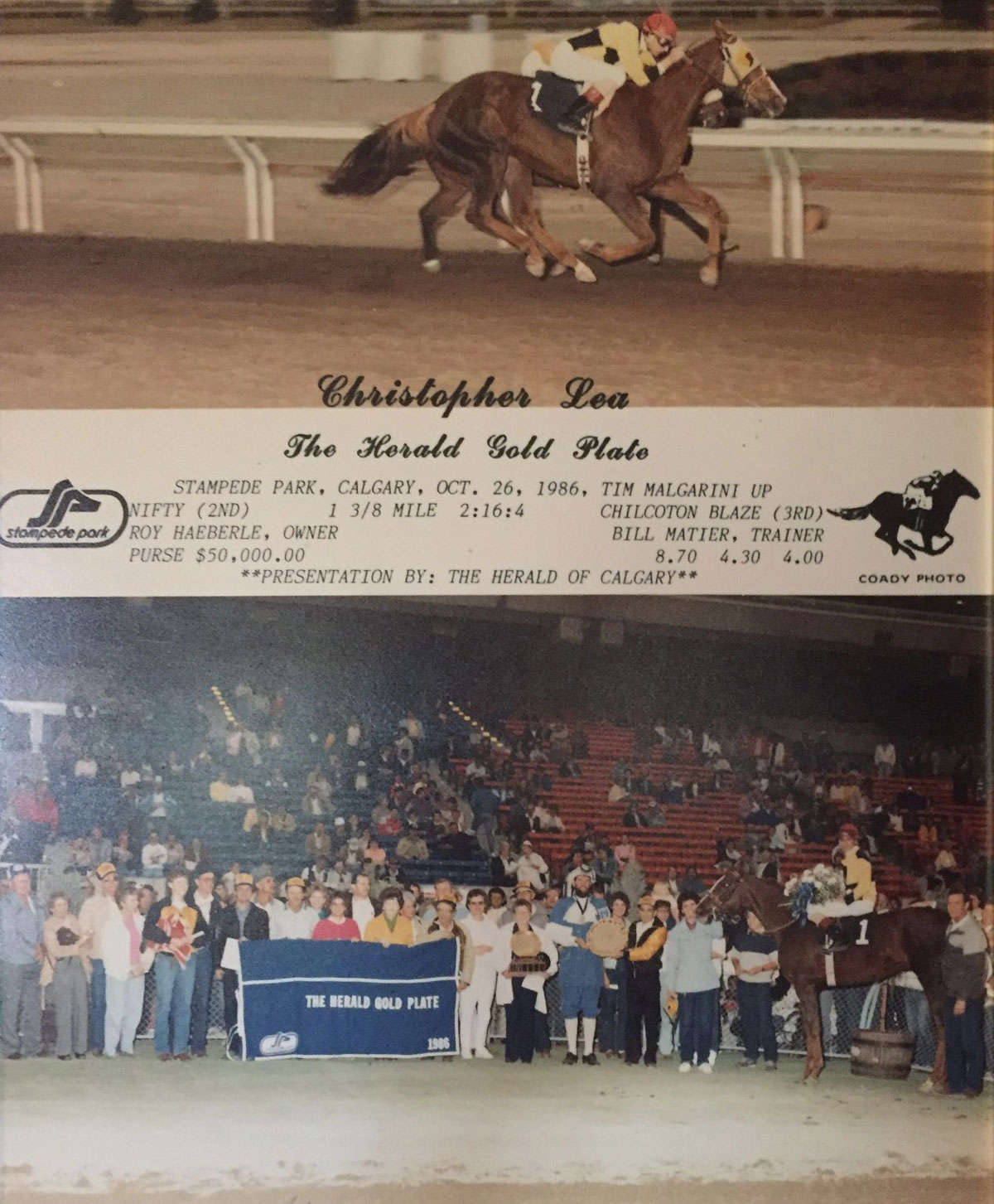
Shirley said he was the ultimate racehorse, “He could go to the front, he could come from behind, he could run on any kind of racetrack.”
Bill adds that Christopher Lea could win at any distance. “He won everything from four furlongs early in the spring in Calgary and then went on to win at a mile and three-eighths.”
In the fall of 1986, he won the Teeworth Plate Handicap, the Thanksgiving Handicap and the Herald Gold Plate Handicap.
But it wasn't just what Christopher Lea could do on the track that made him special to the Matier family. Shirley and Debbie both remember him as an amazing gentleman of a horse, “just as much as you've ever seen.” He also had some unique conformation, with a nearly club foot on one side and a really round, flat California foot on the other. Their farrier at the time, Rod Cone, would look at the horse and say, “Nothing will stop this horse.”
And nothing in the province of Alberta could stop him. In 1986, Christopher Lea was named Alberta Claiming Horse of the Year, Handicap Horse of the Year and Alberta Horse of the Year, a combination of honours that has only been accomplished once. He even brought the ownership group something fun when he won a special race series where the prize was $10,000 or a gold brick plus a trip to Las Vegas for the National Finals Rodeo.
Bill and Shirley took the trip to Las Vegas for the rodeo, while Haeberle chose the money. Shirley now wonders if they shouldn’t have taken the gold brick.
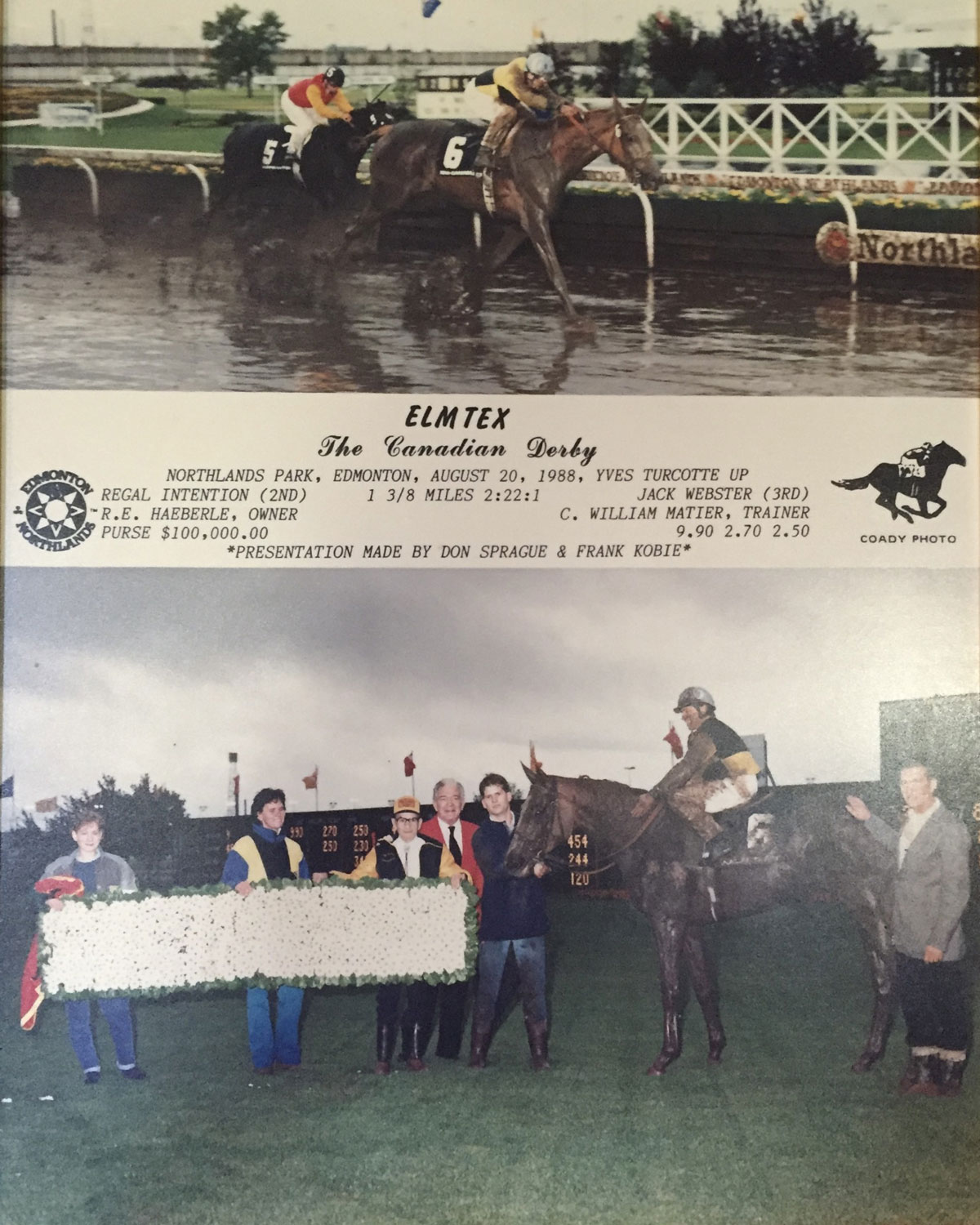
For the Matiers, the claiming game would produce another special horse that would become part of their legacy. Elmtex, the 1988 Canadian Derby winner, had been claimed twice as a two-year-old, first for $9,000 and then for $12,000, before the Matiers laid their own $18,000 claim on him for owner Roy Haeberle.
Shirley tells the story of spotting him, “We were in the winter barn and I was putting a horse on the walker. Around came this horse and he was wild and caused my horse to fall down sort of. I’m looking at this horse and he’s putting it on the walker and I kept looking. Then I went back in the barn and told Bill, ‘Find out what horse that is.’ We ended up claiming him for Roy Haeberle. Once he was claimed, we came back to the barn with him and I told Bill, ‘We’re going to win the Canadian Derby with this horse.’ And it happened! How could it even happen, but it did.”
The 1988 Canadian Derby was the kind of race that makes the perfect horse racing story. The local horse Elmtex, ridden by jockey Yves Turcotte, came from 23 lengths back in the mud, raced without blinkers and beat the reigning Queen’s Plate winner and odds-on favourite, Regal Intention. There was also a storyline with Julie Krone, who became the first woman to ever ride in the Canadian Derby aboard No Malice. Curtis Stock’s headline from the $100,000 1988 Canadian Derby read, ‘Elmtex slays the Derby giant.’
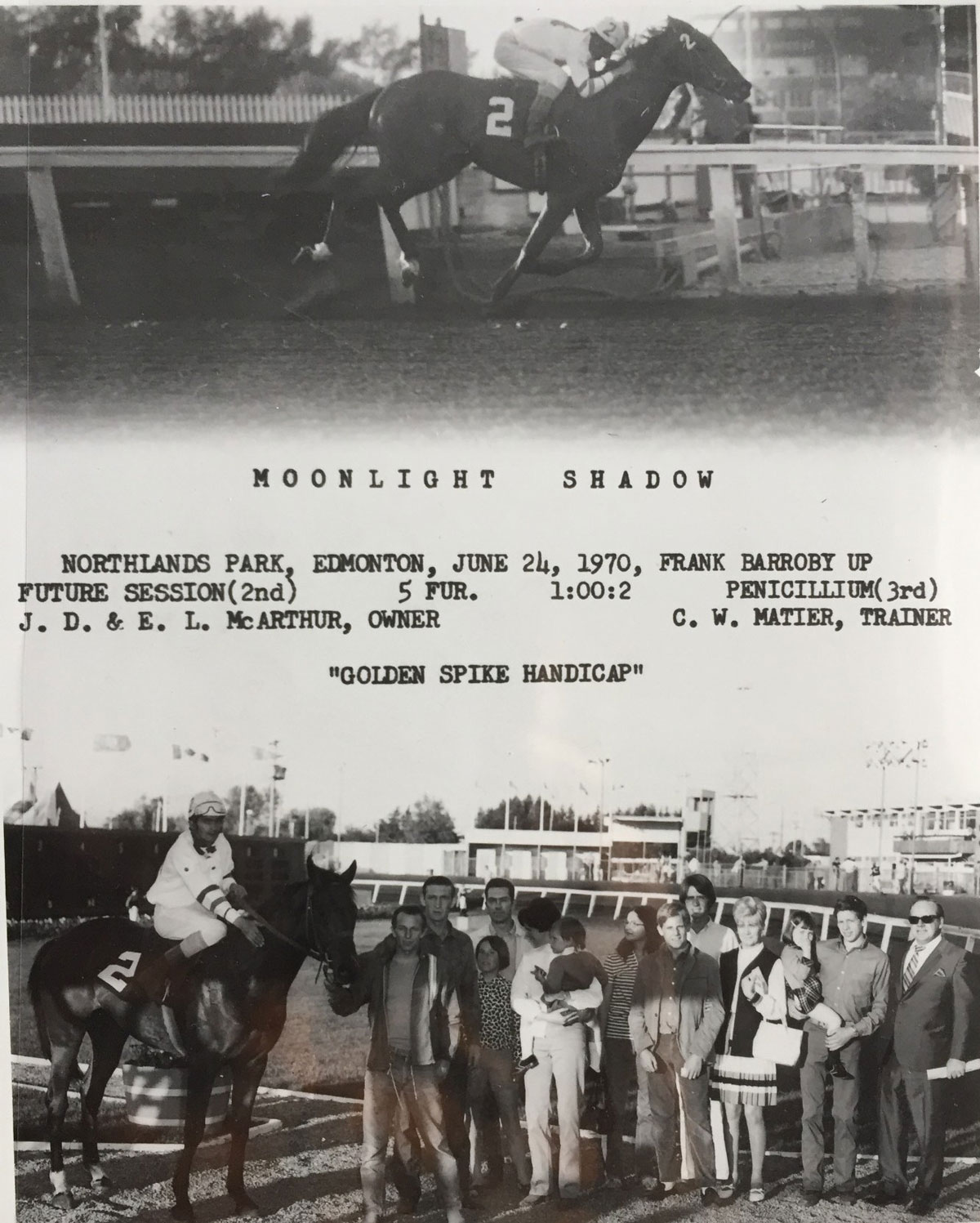
The third horse the Matiers would love to bring back was Moonlight Shadow, a $1,400 purchase at the 1969 CTHS Alberta Sale. When he came through the sale ring, he wasn’t a lot to look at — the cows had even chewed his tail off. It didn't stop him from becoming something special. He won five of seven starts and was named the 1970 Alberta Horse of the Year and Alberta Two-Year-Old of the Year.
Moonlight Shadow had a way of turning up the excitement when it mattered. “When that horse would turn home and come down the lane, he would turn it on. It was so thrilling to listen to the race call, and even announcer Joe Carbury would say, ‘That horse knows where the line is.’”
In 2014, after 51 years in the racehorse training business, Bill and Shirley retired from training. Throughout those years, they were always quick to credit the people around them, their owners, their longtime gallop rider Rick Bunney, their farriers and the many people who helped keep the operation going. The horses may have carried the Matier name, but Bill and Shirley knew it took a whole team to get them to the racetrack and into the winner's circle.
Throughout their training career, the Matiers had always kept one or two broodmares, buying and selling horses through the Canadian Thoroughbred Horse Society – Alberta Yearling Sale, but retirement from the racetrack gave them a chance to spend more time on the breeding side. With the help of longtime family friend and trainer Craig Smith, they began looking for a few Kentucky-breds and gradually built the four-mare broodmare band they have today.
Their wealth of experience is something Dawson Guhle, General Manager of CTHS Alberta, sees as one of the Matiers' greatest contributions to the industry.
“What stands out to me about Bill and Shirley is the depth of knowledge they have of the Thoroughbred industry. Their experience extends across so many aspects of the business, from training and racing to breeding, raising horses and preparing them for the sale. That kind of knowledge, built over decades, is incredibly valuable to our industry.”
That knowledge has also been something the Matiers have been willing to share. Guhle remembers when his own family brought their first yearling to the CTHS Alberta Sale in 2014.
“Bill and Shirley were extremely helpful to us. They answered our questions, offered advice and helped us understand how to prepare and do things the right way. That has always stuck with me.”
Their results as consignors at the annual yearling sale are another reflection of that experience. In 2021, a Value Plus gelding out of Holiday Maker, bred by Bill and Shirley and consigned by C.W. Matier, topped the CTHS Alberta Sale at $32,000. They have continued to bring horses that attract Alberta buyers. In 2024, a Sungold filly sold for $28,000 and Raise Money brought $30,500. A Classic Empire yearling sold for $41,000 in 2025, and most recently, a Knicks Go gelding out of High Fair brought $45,500 at the 2026 sale.
The CTHS Alberta Sale is not the Keeneland September Yearling Sale, and the numbers may look modest to someone accustomed to the million-dollar yearlings and seven-figure sales that make headlines in larger North American markets. But that isn't really the point. In Alberta, those numbers represent buyers competing for horses that Bill and Shirley have bred, raised and prepared, and the confidence they have built in their breeding program over decades.
“They bring well-raised and well-prepared horses to the sale year after year, but what they bring to the industry goes well beyond their own horses. People like Bill and Shirley carry an enormous amount of experience and knowledge, and they have been willing to pass that along and help other people succeed.”
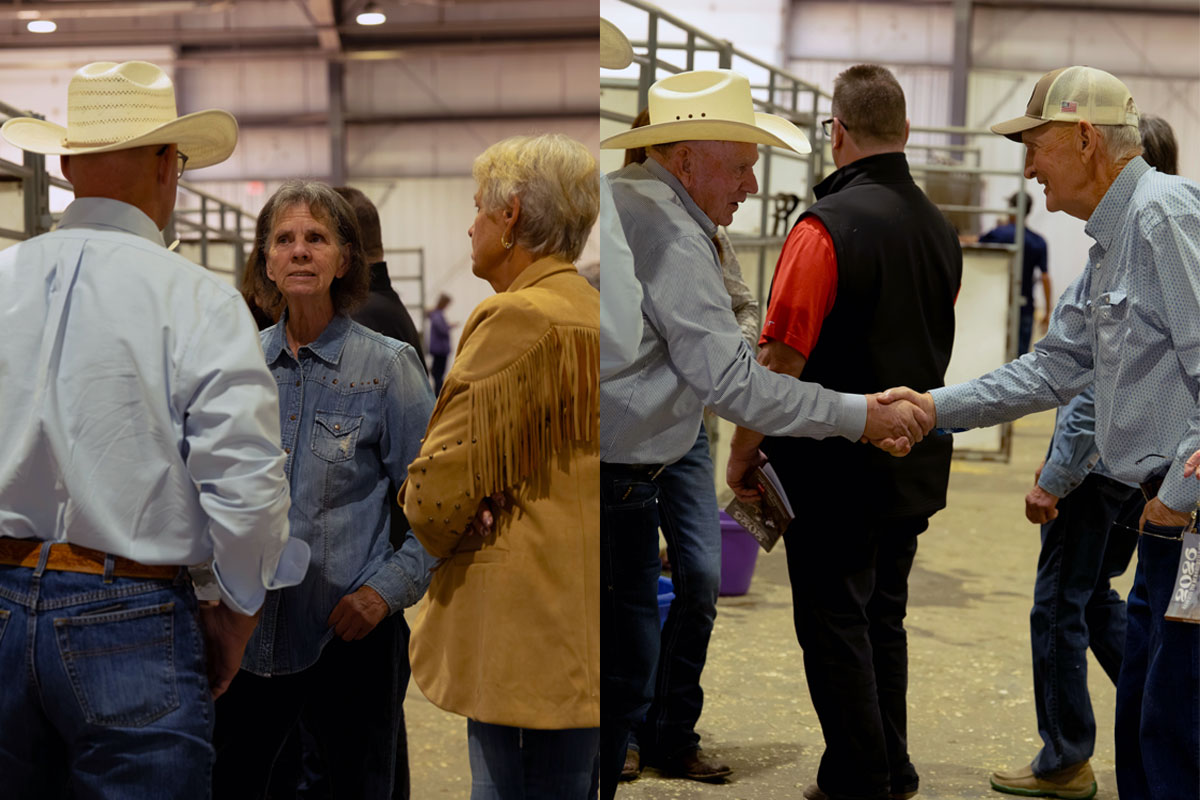
The Matiers are quick to credit trainer and family friend Craig Smith for finding the mares in their current broodmare band, with the exception of Holiday Maker. The 2012 mare by Harlan’s Holiday out of the Empire Maker mare Cozshesaidso is the current star of their breeding program. Holiday Maker earned almost $155,000 on the racetrack before joining the Matier broodmare band. She has since produced multiple horses for Bill and Shirley, including Sixty Six and Holiday’s Again, two homebreds who will carry the Matier name into this weekend’s 2026 edition of the CTHS Alberta Division Sales Stakes Festival at Century Downs Racetrack and Casino.
Sixty Six, a 2023 daughter of Sungold out of Holiday Maker, comes into Saturday’s $50,000 CTHS Sales Stakes for Fillies and Mares off back-to-back runner-up finishes in the $60,000 Alberta Oaks and $100,000 Century Casino Oaks. Bred by C.W. Matier and sold through the Alberta Sale for $28,000 to owner Dorn Ries and trainer Dave Nicholson, she has already earned black-type credentials and now gets another chance at seven furlongs against a strong field.
The connection to Dorn Ries is a familiar one for Bill and Shirley. They trained for him for 27 years, and both called him “the best owner ever.” Now, years after their training days together, a horse bred by the Matiers is carrying Ries’ silks into the Sales Stakes.
Sixty Six will have her work cut out for her this Saturday. The Pat Jarvis-trained superstar Chi Chi Time has been red hot, while Hiway Fortynine, last year’s Alberta two-year-old champion, will also be in the starting gate. For Sixty Six, it is another chance to add to a résumé that is giving her connections plenty to like.
Holiday’s Again is probably one of the strongest recent examples of what the Matier program has been able to produce. Bred by C.W. Matier and sold through the Alberta Sale to Tallie Racing for the bargain price of $18,000, the grey son of O’Prado Again and Holiday Maker quickly proved he was worth more than his sale price suggested. He won the $50,000 CTHS Alberta Two-Year-Old Sales Stakes and followed that with a victory in the $50,000 Birdcatcher Stakes, finishing his two-year-old season with two wins, a second and two thirds from six starts.
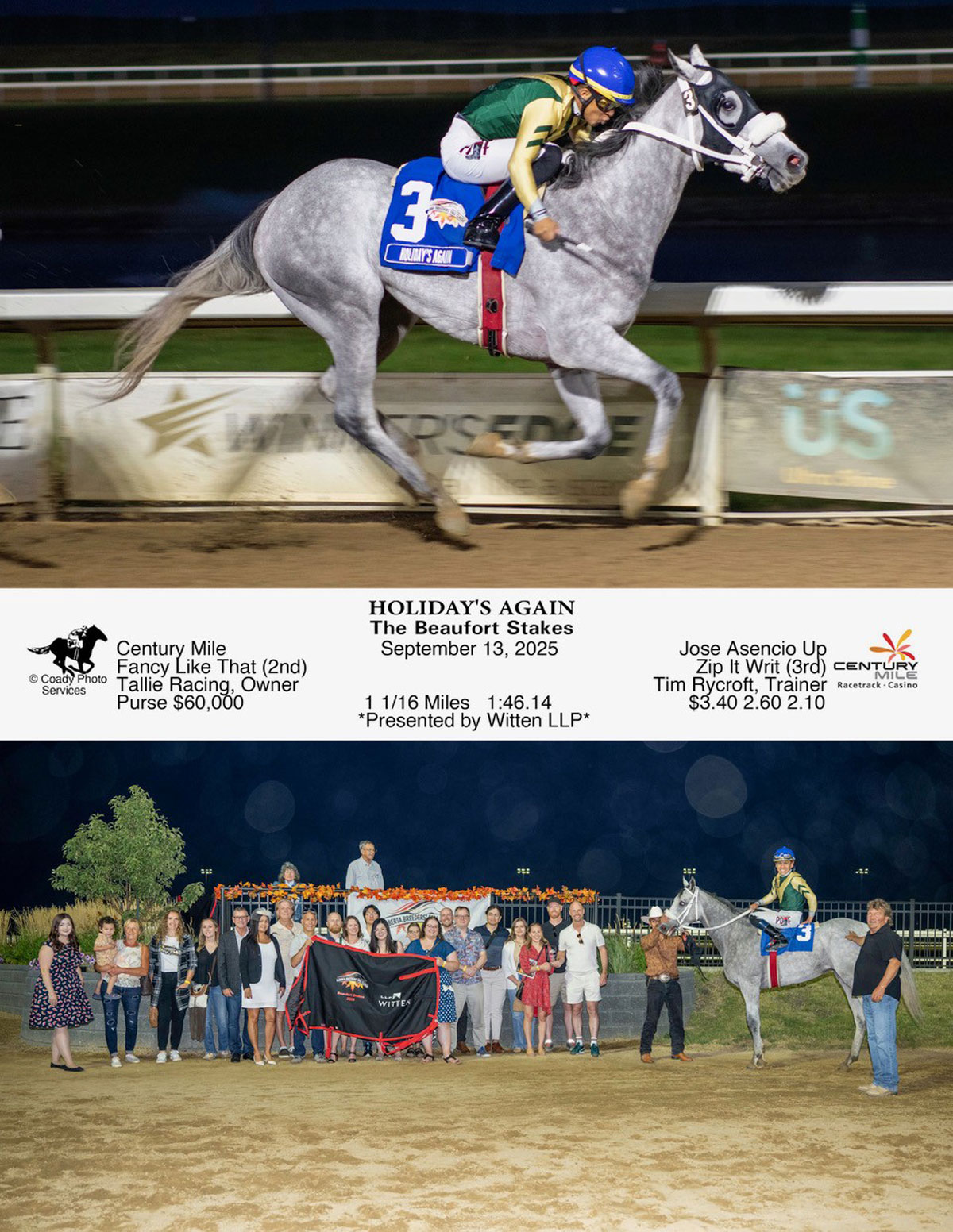
Now a four-year-old with more than $100,000 in career earnings, Holiday’s Again returns to Century Downs this weekend for another $50,000 CTHS Alberta Sales Stakes, this time at seven furlongs against three- and four-year-old Canadian-breds. He faces a compact but highly competitive field of five. The Joan Petrowski-trained River Seven arrives off a win in the $60,000 Red Diamond Express Handicap, while the Robbie Henson-trained Chase ships north from Emerald Downs after finishing third in the $50,000 Muckleshoot Derby Presented by 1 S/T Bet in August.
A lifetime in the industry, and still looking ahead, Bill and Shirley have found a farm sitter and are making the two-and-a-half-hour trek from their farm to watch their homebreds race at this weekend’s CTHS Alberta Division Sales Stakes Festival.
When asked what makes a good racehorse, Bill didn't hesitate.
“A good horse comes from anywhere. They don't know their value.”
The Matiers have spent decades knowing the value of a good horse. And if there is one thing the horse racing industry knows, it is the value of good people. The Alberta horse racing industry is richer for the generations of horses, horsepeople and knowledge Bill and Shirley Matier have given to it.